Wednesday, 30 April 2008

Onto-Historical World

Hoppers World: Edward Hopper lived through some very turbulent times in American life. He was growing as an artist through both World Wars, atrocities no one in the world could comprehend, and the Great Depression, which no doubt affected American Life in a way that would forever influence the modern art movement in both visual art and literature. The painting was created immeidietly following the attack on Peral Harbor, a truly sobering moment for Americans. In the wake of the first real foreign attack on American soil, the paintings character is true to the feelings of the decade. Hopper's obsession with American loneliness and melancholy was no doubt deeply rooted in these tragic times; urban America of the forties is very well represented in Nighthawks.

His combination of American realism and impressionism is the perfect blend to represent this time period, a combination of a reality and the surreal too intense for a people to handle. Turning to the night, the streets could never be as empty as Hopper portrays, and yet, it seems right to make them so.

A podcast about Hopper and his work, also where I drew many of my references from, can be listened to here.

Today's World: I can understand his movement from the sub-urban life in the Hudson Valley to life in the big city, I experienced a similar move in my own life. Urban life can be very lonely, even in today's world. I visited Greenwich Village, the area of Hopper's influence and the supposed location of the infamous diner. The diner has since been demolished, and the feeling of the neighborhood Hopper inhabited so many years ago has changed dramatically. Walking the streets at night, people flooding in and out of bars cheerfully, I don't see the empty feelings of the 1940's resonating in today's streets of New York.

Hopper's work became infamous in the decades after it's creation, and has been imitated and referenced in countless numbers in popular culture, especially in today's world. TV shows like the Simpson's and That 70's Show have built on this tradition.

Virtual Feeling

The poem I wrote was an attempt to convey my virtual feeling of the piece; the melancholy, the loneliness, and the jealousy of the man sitting by himself. I like the duality of certain things in the painting, the light of the cafe versus the dark of the street, salt and pepper shakers, the single man versus the couple, etc. It's as if Hopper is trying to convey loneliness through a contrast of many different elements. Besides the obvious empty streets and late night setting, this painting is almost two-thirds devoid of people. Loneliness is a given.

The woman is the only thing that bothers me. If Hopper was trying to perceive the (ironic) loneliness of the modern urban landscape, why have a loud, hot girl in the mix of the painting? I think the secondary objective here is jealousy. The single man sees the couple, at whatever varied degree of hapiness they may be enjoying or not enjoying, and is simply jealous of them. The red being so vivid, leads me to belief that the jealousy is intense and saddening at the same time. We can't see the single man's face, but I'd imagine its less neutral than the rest of the bunch; I'm pegging him as the protagonist of the story of the painting. He is the voice in my poem as well. Although it's ultimately the loneliness of an entire city that Hopper is trying to convey, he is the one we identify with as truly lonely in this still shot.

I feel like this is a movie, and several things I read supported this; Hopper liked the cinema. I can see the camera zooming out at the end of the shot, to a slow, dizzy saxophone, trailing off into the fade to black.

Textual Representation

The term 'Nighthawks' is probably a disambiguation of the term 'night owl,' a euphemism for someone who is nocturnal in behavior. A 'nighthawk' could be someone who is ferociously nocturnal or self-destructive, 'hawk' brings to mind a sort of violent nature that owl does not.

'Phillies,' the only really clear word present in the painting, an ad for a brand of cigar forever immortalized in the painting. Phillies are still sold today, interestingly enough.

To further the text of the painting, I tried to write my own program in the form of a poem. It's also a nice segway into virtual feeling.

It's called "Phillie's"

sitting alone
in the early morning
where the milkshake man works

in mute white, he bends slightly,

and utters a
question towards my quiet coffee and the salt
and pepper shakers

he is the only person in the world to notice me.

the dress’ loud color
screams in my pastel world
no people in the streets.

milkshake man blends
into the background, white on white.

just look at my predicament
she, unattainable, with another hat
exactly the same as me.

coffee for nighthawks.

something is wrong.
i have a hunch.

more coffee son?

i’m tired of this scene, this mirror where
my reflection has a better suit
and gets to hold hands

Phenomenological "Sound-In-Time"

Unfortunately, as Katie also aptly observed, I cannot experience the painting's "sound-in-time," (the sound of the painting as I stand in front of it) and describing the feeling I get from looking at it would boarder on virtual feeling, which will come later. Instead I opted to graft on some referential work, and listen to the sound-in-time of Tom Wait's "Nighthawk Postcards (from Easy Street)," off the concept album "Nighthawks at the Diner," which is a live recording of Wait's, in a nightclub setting, attempting to recreate the moods of night clubs, jazz, booze, and of course, the loneliness of Hopper's painting. If the painting could speak, it would sound like this.

Listen.

The sound of the piece is the kind of cool, yet suggests the narrator is a bitterly alone night-owl, roaming the streets, boozing, describing the scenes around him. The gruff voice of Waits is humorous and stereotypical of 1950's film noir, but somehow still the perfect narrator for the picture of empty streets and late night diner stops. Waits based the album on the painting, so it can't be too far off in terms of referential meaning.

Syntax

Nighthawks is painted oil on canvas, and measures:
84.1 x 152.4 cm (33 1/8 x 60 in.)

That puts it roughly in the ball park of 3 ft x 5 ft, larger than most would guess. The color scheme is a distinctly drab pastel, composed of blues, grays, browns, and greens. The most eye-catching color of the painting is the woman's dress, which departs from the color scheme, a bright red. It's tough to pinpoint exactly which way the brush strokes went without seeing the actual painting, but from the picture it seems that many of them were strokes rather than the splashes associated with impressionism, a style for which Hopper had a fondness. However, there are some vaguely impressionistic motives in the windows of the diner, as well as the exterior, which seem less comprised of solid strokes. Also, the diner itself is geometrically incorrect; the bar is slanted so that the bartender is seemingly trapped inside, as well as the diner itself having no visible doors or way out. Other than this, the painting is pure realism, and Hopper's preoccupation with shadow play is evident in the many crossing sections of lights and darks, including some shading on the characters present in the painting. Often Hopper's characters wear an indifferent look on their faces, and Nighthawks is no different.

Historical Background


Let's backtrack a little, at the risk of getting carried away with observations. I am familiar with the painting, however, I knew little about it before I started.

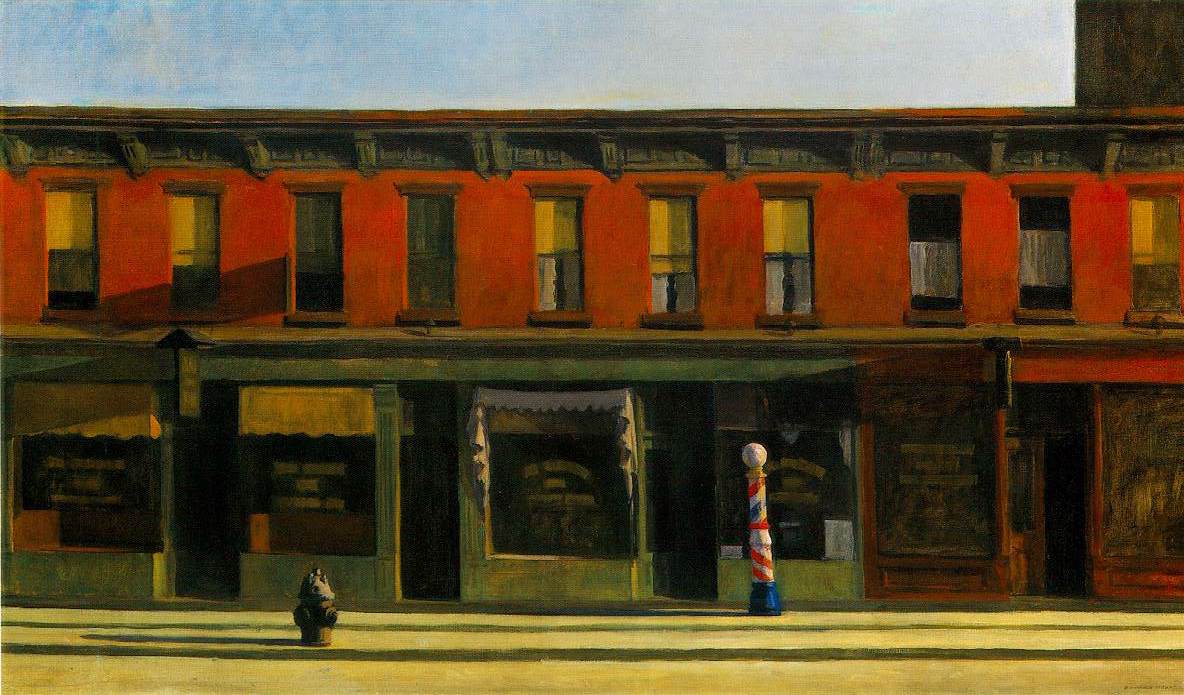
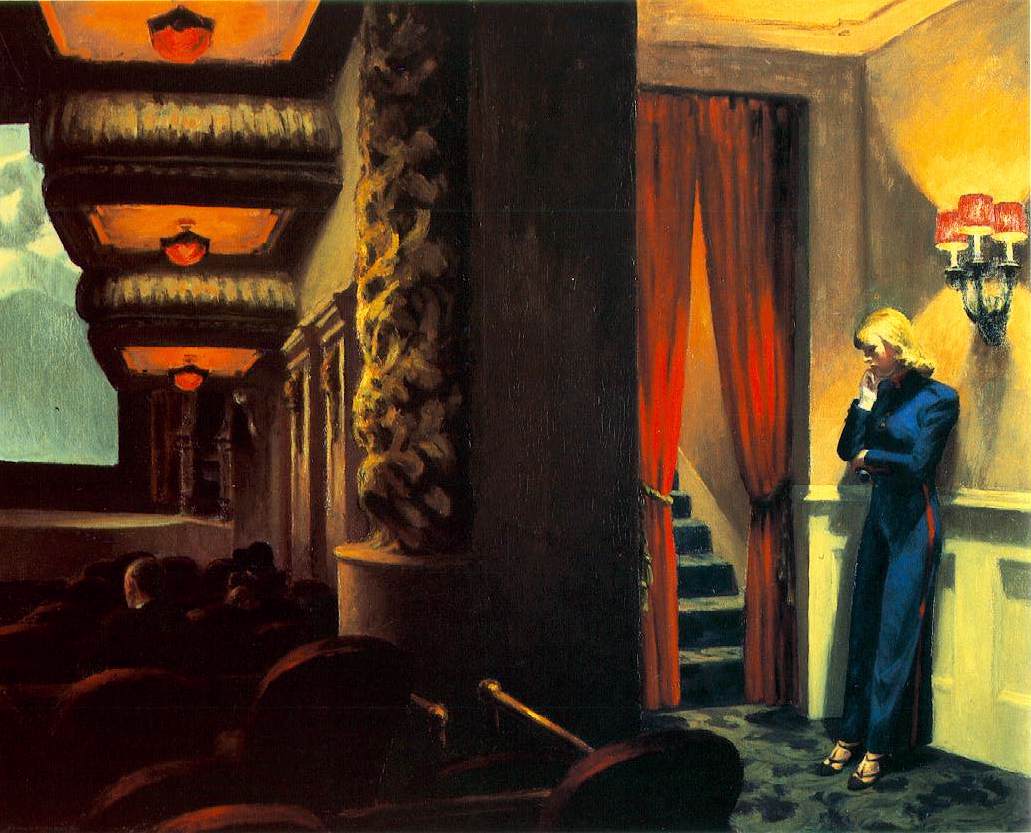
Nighthawks, as it is aptly named, was painted in 1942 by Edward Hopper, an American painter who lived from 1882 - 1967. He painted several other notable works, such as our class favorite Early Sunday Morning, as well as New York Movie, Office in a Small City, and Automat. The painting is often called Hopper's most recognizable work, however, it coincides with his overall theme of the gloom of modern American urban life in the first half of the century. The work was created immediately following the attack on Pearl Harbor.

Pictured Left: Hopper, Self-Portrait.


Hopper was actually born very close to my hometown of Haverstraw, in Nyack, New York. Nyack sits on the Hudson river, on the edge of Rockland County, a forty minute to an hour drive from Manhattan. From there he went on to study in New York City, at the New York Institute of Art and Design. He studied under and was influenced by Robert Henri, another notable American painter, who encouraged his students to not only portray urban life accurately, but to "cause a stir" with their art. Henri's pupils would later collectively be known as the Ashcan School of American Art.

Hopper spent time in Europe, offering him a contrasting perspective to his native New York and American life. Instead of Parisian cubism and abstractions, Hopper was attracted to realism and Victorian architecture. He also grew fond of impressionism, and enjoyed the work of Edgar Degas. He was forced to work as a commercial artist until 1923, when he painted Mansard Roof. He then painted a series of famous, successful paintings which allowed him to dedicate himself professionally and solely to his work. He divided up his time between New York and Truro, Massachusetts. He was often seen as very alienated, up until his death, in his studio near NYU and Washington Square, in 1967. Nighthawks, a beloved piece of Americana, now resides in the Art Institute of Chicago.

Below: Hopper's New York Studio.


Open Viewing

Link

For a closer look at a picture of the actual painting, click on it.

First impressions: loneliness. The unclear contrast of light and dark between the diner and the streets gives off a sort of ambiguity to the time of night; we know it is night, but we're not sure when. The streets and windows are completely empty, as opposed to the diner which seems to have a man by himself, a couple of some kind, and a soda jerk (appropriate term?), bending down, looking out the window. Several questions arise; why is the man with his back to the glass by himself? What is he looking at? What is the soda guy looking at? He appears to have his mouth open, as if he is saying something. The couple are almost holding hands, but the lady is looking at her right hand almost with a twinge of detachment. The three customers all have coffee cups. It appears the concept of "the dead of night" is significant. The name of the diner is "Phillie's," with what appears to be a cigar next to it, costing only five cents. This seems to establish that this is an older time. The clothing is very early 20th century, the men have fedoras and the lady is wearing a sharp red. She almost jumps right out of the painting, painted up in a loud dress with red hair and red lips. Although slightly off center, she seems to be the focus of the paintings desire, a clear contrast against the dull pastels of the rest of the piece. The sheer melancholy of the late-nighters is embodied in this soft, quiet color scheme of blue, gray, green and brown. I find myself questioning: who is comfortable eating alone? What are the connotations of such an action? And do the couple, in their indifference, look down on the lonely man? Upon looking closer, it seems like there is no way out of the diner for either the patrons nor the bartender. What is he, anyway? He almost looks like a milkman.

As Promised: The Eclectic Analysis

Subject: Edward Hopper's Nighthawks

Here we go... I am going to write start to finish tonight, in the hopes of being forward thinking and cohesive, and also spontaneous. Let's begin!

Wednesday, 16 April 2008

what is art? baby don't hurt me.

Hello class. I have sinned. It's been two weeks since my last post.

Anyway, here's a summary of what I read this week:

George Dickie begins his comprehensive institutional analysis of Art and the Aesthetic with a look at the definition of “art,” both in the past and present. He starts with the traditional description of art “as imitation.” Dickie then breaks the definition down into three phases, which are as follows: Phase I: art as imitation, Phase II: art cannot be defined, and Phase III: Dickie’s own work with trying to define art, while avoiding the “difficulties of traditional definitions” and “incorporate the insights of later analysis.”
He then breaks his essay in four sections. The first begins with a discussion of the most well known work to refute art as definable, namely, Morris Weitz’s article “The Role of Theory In Aesthetics.” He goes on to describe the article and it’s points (about the generic conception of certain art, and the classification argument), and then rebuts them utilizing Mandelbaum and his rebuttal of Wittgenstein’s contention that “game” could not be defined. He then moves on to the driftwood example, a strong argument against Weitz. He mentions other authors he has read, like Richard Sclafani, and how they apply. He is obviously well read.
Dickie then establishes three “distinct senses of ‘work of art:’ the classificatory sense, the secondary or derivative, and the evaluative. He plays a few words games with phrases like “this Rembrandt is a work of art” and it’s implications. It does not mean the same thing as “Sally’s cake is a work of art,” and he shows this through his distinct senses.
Dickie then moves on to section II, with the conclusion that “artifactuality is a necessary condition of the primary sense of art.” But this is not the only condition. To further refute claims made about art, Dickie goes into a ‘brief’ discussion of what the “art-world” is, both in the classical and modern sense. He then concludes with a specific definition of what a work of art is, and it’s kind of complicated. It divides into many conditions and notions; one condition in classificatory sense involves art as an artifact, or as appreciated by the art world. The second condition is four variously interconnected notions, acting on behalf of institutions, conferring of status, being a candidate, and appreciation. Dickie discusses them all at length.
In section II, Dickie continues to shoot down Weitz, while establishing his institutional theory of art. Section IV is just a wrap up and a conclusion of what has been said, and what is to come in Dickie’s full work.

REACTION
I’ve always had a problem with ‘abstract art,’ coming from a strong landscapes and imitative background (I use to paint very often, in fact I was going to build a portfolio of landscapes and nature type stuff, and go to art school). However, I chose music as my true calling, and stopped thinking about visual art entirely, and lost touch with the argument in my head about abstract art and it’s definition as far as the art world is concerned. Dickie raises some very intriguing points with his institutional theory, that simply a credible institution can declare something “art” by putting it on display. It’s kind of like the art-world being an exclusive club that only insiders can enter. However, it seems to me, regardless of artistic skill, anyone can transcend the level of classification and become something truly valuable.
But then there is the real value in abstract art, the passion in the creation of it. Dickie doesn’t talk enough about creation and passion, and I think that if he had Youtube at his disposal, like I do, he would easily have made another classification for the definition of art; passion. I advise everyone to check out this video:


Pollock says some really beautiful stuff about painting: “I want to express my feelings, rather than illustrate them. Technique is only a means to a statement” If anything was missing from Dickie, it was this attitude.

Thursday, 3 April 2008

Looks Like We Made It... The Eclectic Analysis!

Finally, we reach the meat and potatoes of Ferrara’s book; his idea concerning the aggregation and utilization of all the various methodologies presented and explored in his book. He calls this multi-step analysis “an Eclectic Method for Sound, Form, and Reference,” and it is the final step in being both freed of preconceptions, while simultaneously allowing the work to mean anything. Needless to say, it’s a tad complex. Ferrara focuses on music but since we have used the method for visual art as well, I will try and make the method universal as I explore it.
First Ferrara establishes the importance of keeping the three major methods (phenomenological, conventional, and hermeneutic) autonomous, while exploring each one properly and fully. The eclectic method must suspend prejudgments of what a work could mean, while simultaneously remaining open to all the possibilities. The method is a step by step process, isolating features through the lens of a specific method, and aggregating all the methods simply by placing them side by side, in a specific order.
First, a historical framework must be established. Strictly speaking from a historical context, what was the climate of the world when this piece was created? This analysis includes the life of the author, the world around them, and any pertinent events in their lifetime leading up to the creation of art. From then on, a narrative point of view should be established.
Next, Ferrara tells the reader to do an open viewing or listening, to hear the work as a whole, hear the sound or see the art, and relay some first impressions unbiased by other works. This step is meant to engage an experience in the work, uninhibited by methodology, and record ideas and impressions. This step deals with referential meaning, and only referential meaning.

The third step is the syntax, the formal analysis of the work. What are the technical elements that comprise this piece of art?
The fourth step is phenomenology, the sound-in-time. Here Ferrara notes a more poetic approach when talking about the work is necessary. Also he reminds the reader that keeping each method separate is key. No referential meaning or formal analysis should occur here.
Step five is the beginning of the three levels of referential meaning. The first is representation of a program or text. Step six is the second level, reporting the manner in which the art is expressive of human emotion or feeling (hermeneutics). Here steps three and four should be included in a dialogue with the referential to differentiate the step and create relations with previous analysis. Step seven is the third level, the onto-historical world of the composer or author, incorporating many elements already discussed.
Step eight is a return to the open-viewing or listening, and pegs the analysis as circular. With everything else in mind, the second open viewing should be more developed, more cohesive, and more imaginative.
Step nine is a performance guide (solely for music I’d imagine), utilizing all of what has been discussed to create a map for the performer, highlighting key aspects. Step ten, the final step, is a meta-critique of the analysis as a whole, and is essential to the effectiveness of the method, in order to unite “theory and practice.”


REACTION

Ferrara’s eclectic method is quite a bit of information to take in and digest, but the idea of taking such a dense volume of method and theory and putting it all together in sort of a super-analysis is kind of cool. The electic method allows for so many varied and unique views on one piece of art that it really is an all-encompasing method. It even has a built-in safe guard step to detect it’s own weaknesses.
My only concern is that most people attempting this complex process will not have the thorough knowledge of each of it’s components. Historical is easy enough, but the average person will not be able to distinguish a phenomenological discussion from a hermeneutic discourse. I understand now why most of the book is pure summary of these views, to give the reader an appropriate framework for using the method. However, I wonder, how important is it to know all of these methods when reading a complete eclectic analysis? Is it necessary? Or does the reader of such an analysis simply get an amazing variety of views without fully understanding?
This led to me to another question, difficult to separate out from an academic setting, (considering we have to do these analysis for a grade, and in that respect the question is moot). Anyway, aside from grades, my question is this: is the eclectic analysis purely for the person conducting the method, or for an unnamed reader to see an all-encompassing view of a work? What is the intention? I’d like to think that the average intellectual would love to sit down and bang one of these babies out, but is it purely for self awareness, or is it meant to be read by others? I now pose this question to all of you.